

Identify the product before cleaning it
Start acoustical ceiling maintenance with the exact product name and manufacturer’s care instructions. Similar-looking panels can have different cleaning limitations. A method suitable for one finish may damage another. Record the panel, suspension, edge detail, and finish so future maintenance is based on identification rather than guesswork.
Keep the USG Ceiling Panel Maintenance Guide (PDF) with your building records if it applies to the installed product. Use the current instructions for your actual ceiling, including any product-specific exceptions. This guide helps organize maintenance decisions; it does not replace those instructions.
Create a ceiling care folder
- Product manufacturer, product code, color, size, and edge detail.
- Approved submittals and any relevant installation records.
- Cleaning and maintenance instructions for the actual product.
- Photos and a simple map of access locations and specialty details.
- Spare panel inventory, stored as the manufacturer requires.
- Contractor contact and any warranty documentation provided.
Label spare stock clearly. A future facilities manager should not need to compare white panels by eye to discover which box belongs to which room. Record substitutions or later replacements as they occur, so the care folder remains useful rather than becoming a snapshot of opening day.
Look for changes during normal building checks
From a safe position, note stains, sagging, chips, dislodged panels, damaged edges, and changes around service penetrations. Record the location and photograph the issue. Avoid disturbing an unfamiliar ceiling or accessing overhead spaces without suitable equipment, authorization, and qualified personnel.
Set inspection timing around the building’s needs and the product guidance rather than an invented universal calendar. Work above the ceiling, a roof or plumbing issue, and changes to room conditions are reasons to check the affected area. Repeated damage in the same location deserves investigation of the cause.
Treat a stain as information—not just a cosmetic defect
A stain may indicate a source that needs attention before the finish is restored. Have the responsible building professional investigate the cause. Replacing a panel without addressing a continuing leak or other source can leave the same problem waiting to return.
Keep people clear of any area with an unsafe overhead condition and follow the building’s response process. Do not use an article to diagnose concealed moisture or hazardous material. Once the cause and conditions are addressed, evaluate the affected panel against the manufacturer’s guidance and the project’s requirements.
Choose the next action deliberately
| What you notice | Practical next step | Avoid |
|---|---|---|
| Light surface dirt | Check the product’s permitted cleaning method | Assuming every tile tolerates water or detergent |
| Staining or recurring discoloration | Investigate the source with the responsible professional | Covering it up before the cause is resolved |
| Broken or damaged edges | Review replacement with a matching approved product | Forcing a damaged panel back into place |
| Sagging or movement | Have the condition assessed before disturbing it | Treating it as a purely cosmetic issue |
| Damage after service work | Record the location and coordinate a repair | Leaving loose or ill-fitting pieces unattended |
These are triage prompts, not repair instructions. The person responsible for the building should decide who inspects, cleans, or replaces each item and what access controls the work needs.
Keep cleaning conservative and product-specific
Do not improvise chemical mixtures, saturate panels, or scrub an unfamiliar finish. Read both the ceiling manufacturer’s instructions and any cleaner instructions. If the approved process calls for testing a discreet area, do that before treating a visible expanse. Protect adjacent finishes and building equipment as appropriate.
Painting is not a universal refresh strategy for acoustical panels. Before recoating, confirm whether it is permitted and how it affects the particular product’s finish and performance. Replacement may be a better conversation than applying a coating that was never part of the approved system.
Protect the ceiling during other maintenance
Ceiling damage often appears after unrelated work. Identify planned service access, arrange proper access equipment, and use personnel familiar with the ceiling system. Keep removed components protected and labeled where needed. Reinstall according to the applicable instructions and inspect the finished area afterward.
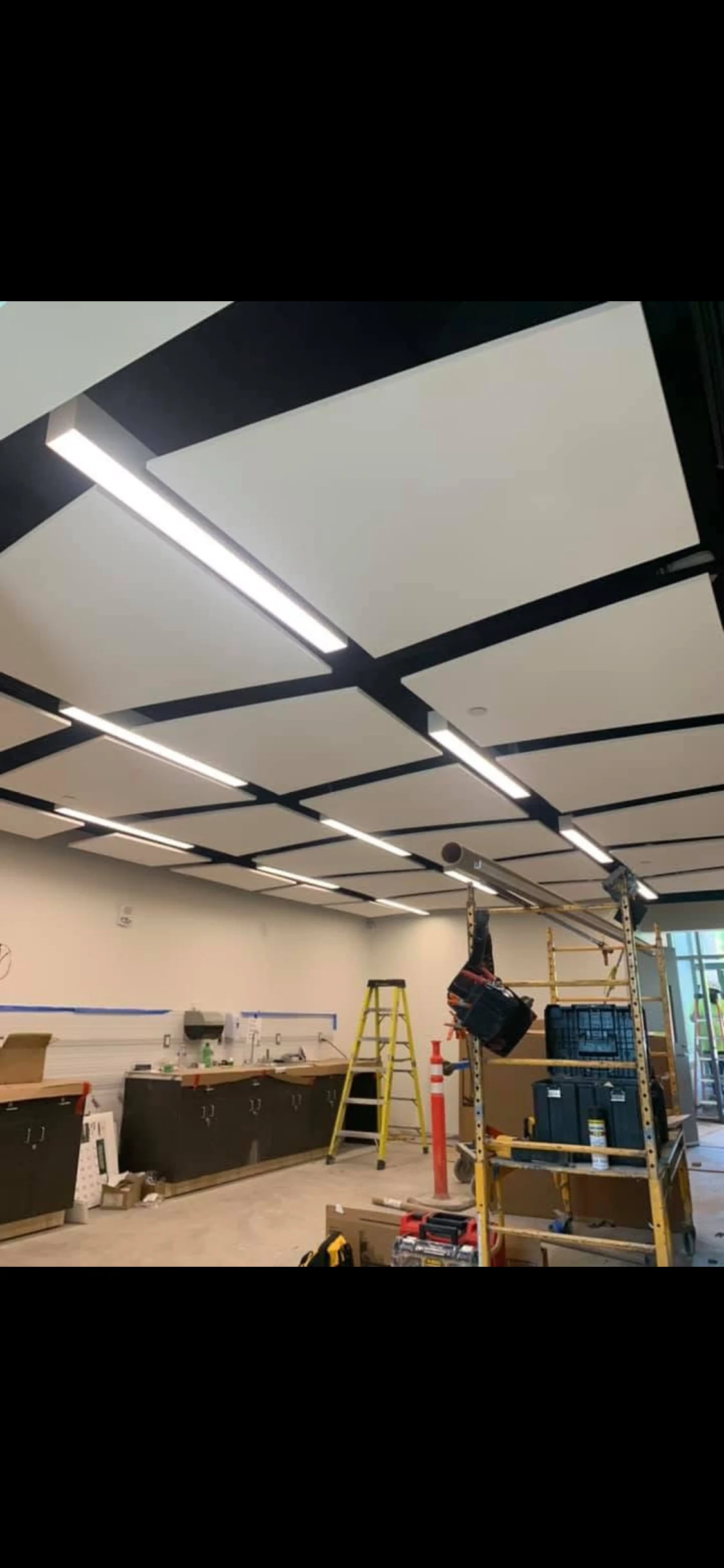
Clouds and specialty details may have different service procedures from removable lay-in panels. Do not assume that every overhead element is designed to be lifted, moved, or used as an access route. Ask for the intended maintenance procedure at installation handover, while the responsible project team is still available.
Your ceiling maintenance record
Use this worksheet to organize what you know before calling a contractor or designer. Leave unknown items marked “to verify” rather than guessing. Keep the completed version with your photographs and drawings, and update it when a selection or site condition changes.
- Room and panel/grid location
- Product manufacturer, code, size, edge, and color
- Date and description of observed issue
- Photo record and whether the issue is recurring
- Source investigation or qualified assessment needed
- Applicable manufacturer care instructions
- Action authorized, responsible person, and completion date
- Replacement product/spare stock used and follow-up observations
For each unresolved item, name the person responsible for an answer and the point in the schedule when that answer is needed. A brief that separates confirmed facts from assumptions is more useful than a polished document with uncertain details.
Download the plain-text worksheet ↗ — save, edit, or print it for your project.
Plan replacements for consistency
Confirm the exact replacement product and detail before ordering. Review the appearance of new stock beside existing material, especially after years of use. Discuss whether an isolated replacement or a more coordinated area of work will produce the desired result. A matching nominal size alone does not establish compatibility.
For a renovation or ceiling replacement conversation, send Epic photographs, product records if available, the project location, and a description of the issue. Contact Darren to discuss scope. If you are considering a new system rather than a repair, begin with the ceiling selection guide.
Common questions
Can I wash any acoustical ceiling tile?
No. Cleaning methods depend on the exact product and finish. Follow the manufacturer’s instructions for the installed panel.
Should I paint over a stained tile?
First investigate and resolve the source of the stain. Confirm any proposed coating with the product manufacturer; painting is not a universal repair.
What information makes replacement easier?
Keep the manufacturer, product code, dimensions, edge detail, color, installation records, and labeled spare stock.
TURN PLANNING INTO A CONVERSATION
Bring Darren your room, your plans, and your questions.
Epic Interiors is based in Howell, Michigan. Discuss the project location, scope, and availability directly.
Discuss your project ↗Keep planning
- Ceiling Renovation in an Occupied Business: A Practical Phasing Plan
- How to Choose an Acoustical Ceiling for a Commercial Space
- Ceiling Clouds: A Planning Guide for Commercial Interiors
- A Quieter Fitness Studio: Plan Acoustics Before the Build-Out
- Commercial Interior Build-Out Checklist: Get a Clearer Carpentry, Drywall and Ceiling Bid